
Blog
Central Vacuum Inlet Valves Explained

The inlet is the only part of a central system most people interact with, and it does more than provide a hole in the wall. Central vacuum inlet valves seal the pipe when closed, switch the motor on when a hose is inserted, and set the geometry of every cleaning run in the house.
Here is how they work and how to choose and place them.
What happens when you plug the hose in
Behind the plate, an inlet valve has three jobs. It holds a spring-loaded door that keeps the pipe sealed when nothing is connected. It provides a socket that grips the hose cuff. And it carries two low-voltage contacts that complete a circuit when the hose is pushed home.
That circuit is what starts the motor. It runs on 24V, not mains, along a pair of 22-gauge conductors that follow the pipe back to the power unit. So there is no mains wiring at the inlet, which is why the work is well within reach of a competent DIYer, though it should still follow the practice set out by the NFPA for cable run in walls.
Why one open inlet weakens the whole house
Because the door is what seals the pipe, an inlet that does not close fully lets the system pull air from there rather than from your hose. One inlet ajar upstairs is a very common cause of weak suction at every other inlet, and it is the first thing to check.
The range, and what fits where
Our installation range covers inlet valves in several formats: the AS-40 and AS-50, the P-01 and P-10, and the P-93 utility valve. Alongside them sit the P-series fittings, elbows, sweep tees, couplings and mounting plates that make up a run.
Mounting plates matter more than people expect. The P-19-A suits 3 by 5 inch valves while the P-19 suits square ones, and getting the plate right at rough-in stage saves a repair later.
A VacPort is not an inlet valve
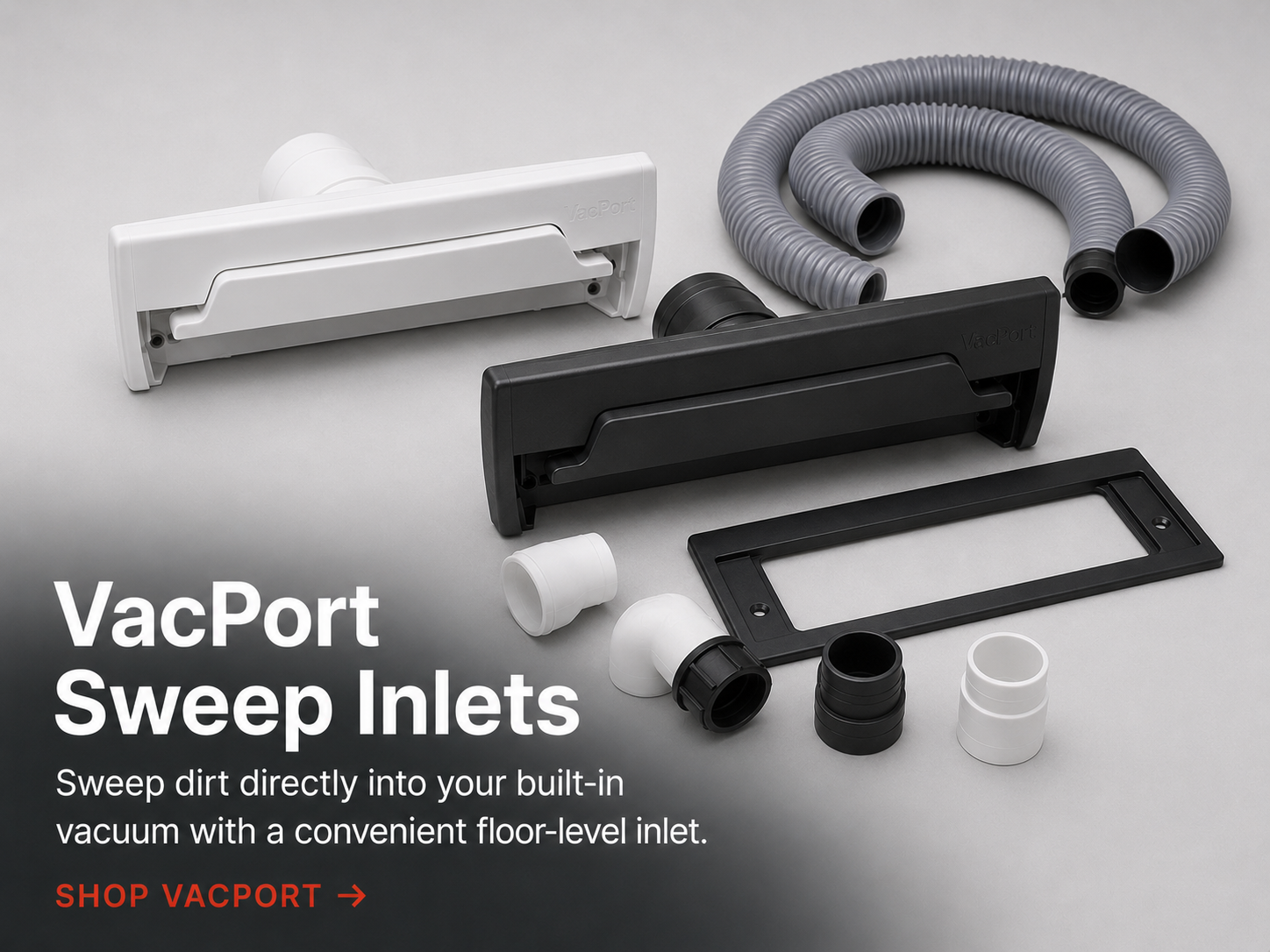
This confuses people constantly, so it is worth stating clearly. A VacPort is an automatic dustpan, usually fitted into a toe kick or the base of a cabinet. You sweep debris to it, tap it open, and it takes the pile away without you bending down.
It works alongside inlet valves rather than instead of them. Our range runs to seven versions, LED and non-LED, plus a complete install kit. They need a 24V AC or DC low-voltage supply, and on 24V DC the wires sometimes need reversing. That requirement is why VacPorts fit most brands of central vacuum, not only ours, which makes them the one product we sell that suits a competitor’s system.
Which systems accept inlets at all
Only piped systems. This is the distinction that governs everything else in our range.
- Piped, and therefore inlet-compatible: the InterVac Pro, the H-120-E, the RM family, the CSRM and CSRM-RC.
- Self-contained, and therefore not: the GarageVac GH120, the GH120-E-RC, the RoadVac CS-6 and CS-8.
On a self-contained unit the inlet is built into the housing itself. No adapter changes that. If inlets or a VacPort are part of your plan, choose a piped unit from the start.
Placing inlets well
Work from hose length rather than from room count. With a 35+ ft hose, one inlet covers a working radius of roughly thirty feet once you allow for furniture and doorways.
That usually means one inlet per floor in a compact home and two or three per floor in a larger one. Three placements earn their keep more than any others:
- Near the stairs, because stairs are the job people install a system for.
- In the garage, for vehicle interiors and the door track.
- A kitchen-level VacPort, which saves more bending than anything else in the house.
Height and orientation
Mount inlets at standard outlet height or slightly above, and keep them clear of where furniture will sit. An inlet behind a sofa is an inlet you will stop using.
Maintenance
Inlet gaskets perish slowly and are cheap to replace. Once a year, open each door, check the gasket for cracks, and make sure the contacts are clean and unbent. If a particular inlet has stopped starting the motor, the contacts are the first suspect, not the power unit.
Our VacPort troubleshooting guide covers the automatic dustpan side, and the weak suction checklist puts inlet seals in the right diagnostic order.
Inlet questions
Can I add an inlet to an existing system?
Usually yes, provided the power unit has capacity in hand. You are tapping the nearest run with a sweep tee, extending the low-voltage pair, and cutting in a plate. It is a half-day job in an accessible location.
Why does one inlet not start the motor?
The contacts inside that inlet are the first suspect, followed by the low-voltage connection behind it. If every inlet fails to start the motor, the problem is at the unit end rather than the inlet.
Do inlets need power?
Only 24V low voltage, carried on two 22-gauge conductors alongside the pipe. There is no mains wiring at an inlet, which is what keeps the work within reach of a competent DIYer.
Can I use another brand’s inlet plate?
Sometimes, since 32mm is a common size, but the electrical arrangement varies between manufacturers. Match the plate to the system rather than to the wall colour.
Are VacPorts worth adding later?
They are one of the few upgrades owners consistently say they should have done sooner, particularly in a kitchen. The requirement is a piped system and a 24V supply, so check your unit type before ordering.
Planning a run
If you are laying out a system, decide inlet positions before you decide pipe routes, then adjust the routes to suit. Doing it the other way around gives you inlets in odd places and a house that never quite feels covered.
Our installation guide covers the full sequence, and the VacPort range is worth a look before you finalise the kitchen.