
Blog
Powering a Vacuum in an RV: Amps, Circuits and Shore Power

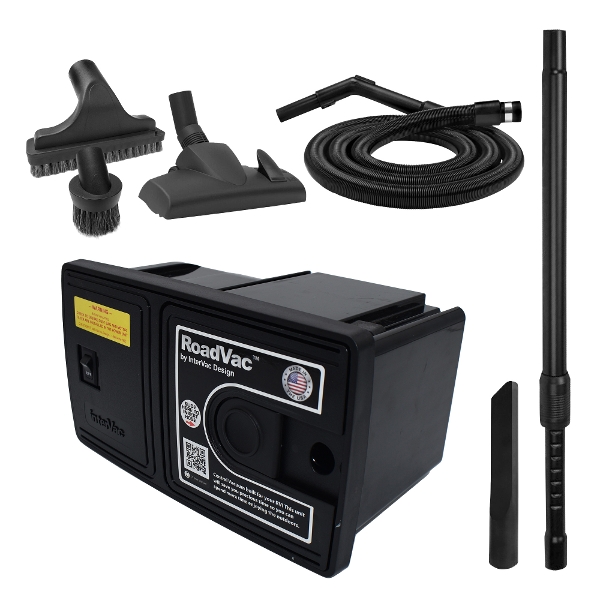
Most people choose an RV vacuum on size and forget the electrical side entirely. Then the first time they clean while the air conditioner is running, the breaker goes. RV vacuum power is a real design constraint, and it is worth understanding before you mount anything.
Here is what actually draws what, and how to plan around it.
Your supply is smaller than a house
A typical coach runs on a 30-amp shore connection, and many run 50-amp. Either way, the total is shared by the air conditioner, the converter, the water heater, the microwave and every outlet in the rig. A house has that much capacity per circuit.
Generator output is tighter still, and inverter capacity tighter again. So the question is never simply whether the vacuum fits your supply. It is whether it fits your supply at the same moment as everything else you have switched on.
Motor inrush is what trips breakers
A vacuum motor draws a brief surge at start-up that is well above its running current. That surge is short, and a breaker with headroom absorbs it without noticing.
The problem arrives when you are already close to the limit. Then the inrush is the straw that trips it, which is why the fault seems intermittent and always happens on the hot afternoon when the air conditioner is working hardest.
The practical rule
Do not run the vacuum and the air conditioner on the same circuit at the same time if you are on a 30-amp connection. Cleaning takes ten minutes. Switching the air conditioner off for that period costs you nothing.
The model that solves it properly
Our CS-6 was designed for exactly this constraint. It includes built-in power management that prevents the unit from overloading a 20-amp circuit, and it is hardwired rather than plugged into an outlet.
If your rig has limited power, or if you are speccing a production build where the electrical budget is fixed, that is the model to look at. It is a deliberate engineering answer to the problem rather than a compromise.
The rest of the line
Every other RoadVac model runs on a standard 120V, 60Hz supply, with 240V single phase available on request for export or specialist builds. The CS8 is self-contained with a short power cord. The CSRM is remote-mounted and automatic, running on a circuit board with dual inlets.
Coverage across the line is the same, up to 900 sq ft, so you are choosing on mounting and power rather than on capacity.
Hardwired or plugged in
A hardwired install is tidier and removes the risk of a plug working loose on the road. It also means the unit is part of the coach electrical system, so it should be installed to the standards the industry works to. Those are published by the RV Industry Association, and any production or warranty-sensitive install should follow them.
A plugged-in unit is easier to retrofit and easier to remove. If you are adding a vacuum to a coach you did not build, that is usually the sensible route.
Running off battery or inverter
Short answer: possible, but plan for it. A vacuum motor is a heavy load for an inverter, and the inrush matters more here than on shore power. If battery operation is important to you, size the inverter for the surge rather than the running current, and expect a meaningful hit on the bank for even a short clean.
Most owners find it easier to clean at the dock or on the generator and leave the batteries for other things.
Power questions
Will a vacuum run on a 15-amp circuit?
Often yes on its own, but not alongside a significant second load. The safest approach in a coach is to treat the vacuum as something you run on its own for ten minutes rather than something that shares a circuit continuously.
Why does the breaker trip only sometimes?
Because the start-up surge is only a problem when the circuit is already loaded. That is why the fault seems random and always happens on the hottest afternoon, when the air conditioner is working hardest.
Does a longer run of wire matter?
Voltage drop over a long run reduces the supply the motor actually sees, which makes it work harder. On a hardwired install, size the conductor for the run length rather than for the nameplate current alone.
Can I fit a soft start?
Rather than adding a device, look at the CS-6, which has power management designed in. Bolting an aftermarket controller onto a vacuum motor is not something we would recommend or warrant.
What about 240V?
Available on request across the line for export and specialist builds. The 240V circuit board is a stocked part, which also means a unit can be specified for a market outside the US.
A note on generators
Generator output behaves differently from shore power under a surge. A generator running close to its rating will sag briefly when the vacuum starts, and on some units that shows up as a stumble rather than a trip.
If you clean while running a generator, do it before you switch other heavy loads on rather than after. Starting the largest load first is generally the easier sequence for any small generator.
Where the exhaust goes matters too
One more design point that belongs in the same conversation. Our CS line carries no exhaust filter by design and offers an overboard exhaust option instead, venting outside the living space entirely. In a cabin this small, venting beats filtering, and it costs nothing electrically.
Our note on what RV owners get wrong about onboard vacuums covers the mistakes that follow from ignoring this, and the CS8 vs CSRM comparison covers the mounting decision.