
Blog
Where to Mount a Garage Vacuum for the Best Reach

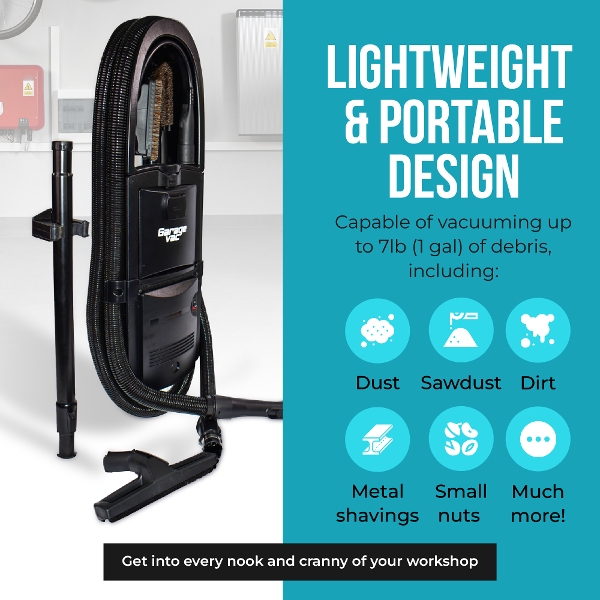
Mounting position decides how useful a wall unit turns out to be. Get it right and one hose covers both cars and the full floor. Get it wrong and you are dragging hose around a bumper every time. Working out where to mount a garage vacuum takes about ten minutes with a tape measure and saves years of small irritation.
Here is the method.
Map your reach before you drill
Take a piece of string the length of your hose, which on our units is 35+ ft. Pin one end at each candidate position in turn and swing it around the garage.
You are checking three specific targets: the far corner of the floor, the rear footwell of the vehicle parked furthest away, and the garage door track at both ends. If a position reaches all three, it works. If it reaches two, keep looking.
Remember that hose does not travel in straight lines
String measures the theoretical distance. In practice the hose has to go around a parked car, not through it. Subtract roughly 15 percent from your string test to account for that, or simply walk the route with the string held at waist height.
Height: chest level, not head level
Mount the unit so the hose outlet sits at roughly chest height, around 48 to 54 inches from the floor for most people. That puts the hose at a natural working angle and keeps the bag door within easy reach.
Too low and the hose drags on the floor at the unit end, which wears the cuff. Too high and you are on a step stool every time you change a bag, which is how bag changes get postponed.
Pick the wall the car does not touch
Avoid the wall a car door opens against, and avoid the wall behind where you park nose-in. Both put the unit at risk of a knock and both make the hose route awkward.
The best position in most two-car garages is on a side wall, roughly a third of the way in from the garage door, on the side you walk past. That position sees both vehicles and the door track without the hose crossing a parking space.
Get the outlet right
Our units run on a standard 120V supply. Plan for the outlet to be within reach without an extension cord, because a permanently installed appliance on an extension lead is a bad idea in a garage and generally at odds with the electrical practice set out by the NFPA.
If the nearest outlet is awkward, have one added before you mount rather than after. It is a much smaller job when the wall is still bare.
Fix into structure
Find studs and mount into them. Drywall anchors alone are not adequate for a unit that will be pulled sideways by a hose several times a week.
On block or concrete walls, use masonry anchors rated well above the unit weight. The GH120 unit itself is around 9 lb, but the working load comes from the hose being pulled, not from the mass hanging on the wall.
Leave clearance around the door
Check the bag door has full swing before you drill. Shelving installed later is the usual culprit here. Leave a hand’s width above the unit as well, for the exhaust and for the occasional filter change.
Two units beat one bad position
In a deep three-car garage, or a garage with a separate workshop bay, one mounting point sometimes cannot cover everything. Rather than accepting a poor compromise, consider a second unit for the far zone.
It is a smaller cost than most people assume, and it means neither zone depends on the other. The GH120 is $279, and both models are self-contained, so a second unit needs nothing but a wall and an outlet.
Mounting questions
How high is too high?
If you cannot open the bag door and pull a bag out while standing flat on the floor, it is too high. Bag changes get postponed when a step stool is involved, and a postponed bag change is a suction complaint waiting to happen.
Can I mount it outside the garage?
Only in a sheltered, dry location. These are indoor appliances, and weather exposure will find its way into the housing. A carport wall is not the same as an enclosed garage.
What about mounting behind a door?
Check the door swing before drilling, including a door opened fully against the wall. It is a surprisingly common oversight and an annoying one to correct.
Does the wall need to be finished?
No. Bare studs, drywall, block and poured concrete all work, provided the fixing suits the material. On bare studs, add a plywood backing plate to spread the load.
Should I mount near the garage door or at the back?
Roughly a third of the way in from the door, on a side wall, suits most two-car garages. That position sees both vehicles and both ends of the door track without the hose crossing a parking space.
A quick checklist before you drill
- String test from at least three candidate positions.
- Confirm reach to both vehicles and the door track.
- Set height so the outlet sits at chest level.
- Confirm a 120V outlet within reach, with no extension cord.
- Locate studs or use masonry anchors.
- Check the bag door swings clear of shelving.
Ten minutes of this saves a repositioning job later. If you are still choosing a model, our guide to choosing a garage vacuum covers hose reach and running costs, and the garage vacuums page lists the range.