
Blog
How to Vacuum a Car Interior Properly

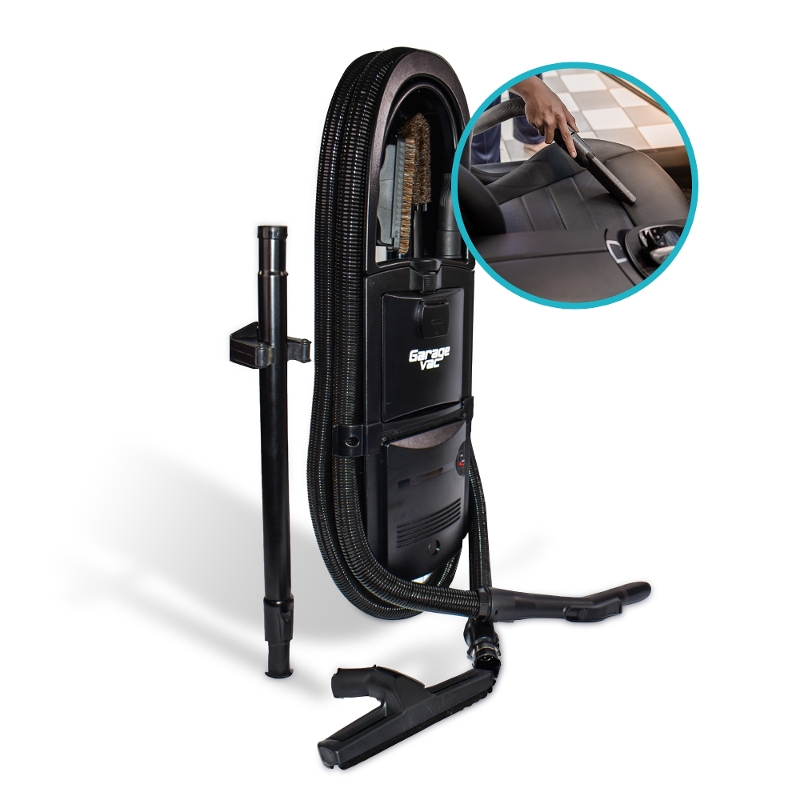
Most people vacuum a car interior in about six minutes and miss half of it. The mats get done, the visible carpet gets done, and everything that matters is still there in the seat rails, under the seats, and in the gap where the carpet meets the sill.
Here is a method that takes fifteen minutes and actually finishes the job.
Set up so you are not fighting the hose
Before you start, park with enough clearance to open all four doors fully, and open them. Then get the vacuum positioned so the hose reaches the far footwell without tension.
This is where a wall-mounted unit earns its keep. A 35+ ft stretch hose reaches both sides of a car from a single mounting point, so you are not moving a machine around the vehicle or hunting for a second outlet. Our guide to where to mount a garage vacuum covers getting that reach right.
Step one: take everything out
Mats, child seats, boot liner, the contents of the door bins. All of it. Anything left in the car is a place you will vacuum around rather than under.
Do the mats separately, outside the car, on a hard surface. Beating them first releases far more than vacuuming alone will.
Step two: work top down
Headliner, then vents and dashboard, then seats, then carpet, then boot. Gravity is not negotiable, and doing the floor first guarantees you do it twice.
A soft dust brush handles the dashboard and vents without scratching. Keep the crevice tool away from screens and piano-black trim, where a hard plastic edge will mark the surface.
Move the seats
Slide each front seat fully forward, vacuum behind it, then fully back and vacuum in front. The rails collect an extraordinary amount of grit and it is the single most-skipped step in the job. Detailers treat it as standard, and the training standards published by the International Detailing Association reflect that level of thoroughness.
Step three: the crevice work
The seat-to-backrest join, the gap beside the centre console, the seat belt anchor points, and the channel where carpet meets sill. These four places hold most of what you are trying to remove.
Use a crevice tool and go slowly. Speed is what leaves material behind, because the airflow needs a moment to lift anything wedged in a gap.
Step four: agitate the carpet
Carpet fibres hold grit that suction alone will not lift. A stiff brush, or a turbo brush on the hose, loosens it so the vacuum can take it away.
Work in overlapping passes in one direction, then again at ninety degrees. The second pass always brings up more than you expect, which tells you how much a single-direction pass leaves behind.
Step five: the boot and the spare well
Lift the boot floor and do the spare wheel well. In most cars it has never been cleaned, and in an older car it is where you will find out whether the seal is still doing its job.
While you are there, check for damp. A wet spare well is a problem worth catching early, and it is not something a vacuum should be used on.
Tools that make the difference
You want three: a crevice tool, a soft dust brush, and either a turbo brush or a stiff upholstery brush. A full-size floor tool is nearly useless in a car.
All our tools use a 32mm fitting and work across every system we build, so a kit bought for a house system works on the car too. They also fit 32mm inlets from other brands. The range is on our accessory kits page.
Why a remote handle helps here
Car work means constant stopping: moving seats, repositioning, swapping tools, picking up a coin before it goes down the hose. With a wall switch, each stop means walking back or leaving the motor running.
That is the strongest case for the remote-control GH120, and it is the use where owners notice the difference most. Our note on whether the remote is worth it weighs it up honestly.
Car cleaning questions
How often should I do this properly?
A quick pass every few weeks and a thorough job twice a year suits most cars. If you carry pets or children, the thorough job earns its place quarterly.
Will a turbo brush damage car carpet?
Not on ordinary automotive carpet, which is tougher than household pile. Keep it off leather, headliners and any exposed trim, where a soft brush is the correct tool.
What about pet hair?
Suction alone struggles with hair woven into carpet. A turbo brush or a stiff rubber brush to lift it first makes a much larger difference than more suction would.
Can I vacuum the engine bay?
Loose leaves from the cowl, yes, with the engine cold. Anything beyond that risks pulling in oily residue that will ruin a bag and coat a filter.
What is the most-missed spot?
The seat rails, followed by the channel where carpet meets the door sill. Both hold more grit than the open carpet, and both take under a minute once you know to do them.
One rule to finish
Never put a dry vacuum on anything wet. Damp carpet, a spilled drink, melted snow in a footwell: dry the area first, or use a machine designed for liquid. A wet pickup in a dry system ruins bags, filters and eventually the motor.