
Blog
Is a Remote Control Garage Vacuum Worth the Extra?

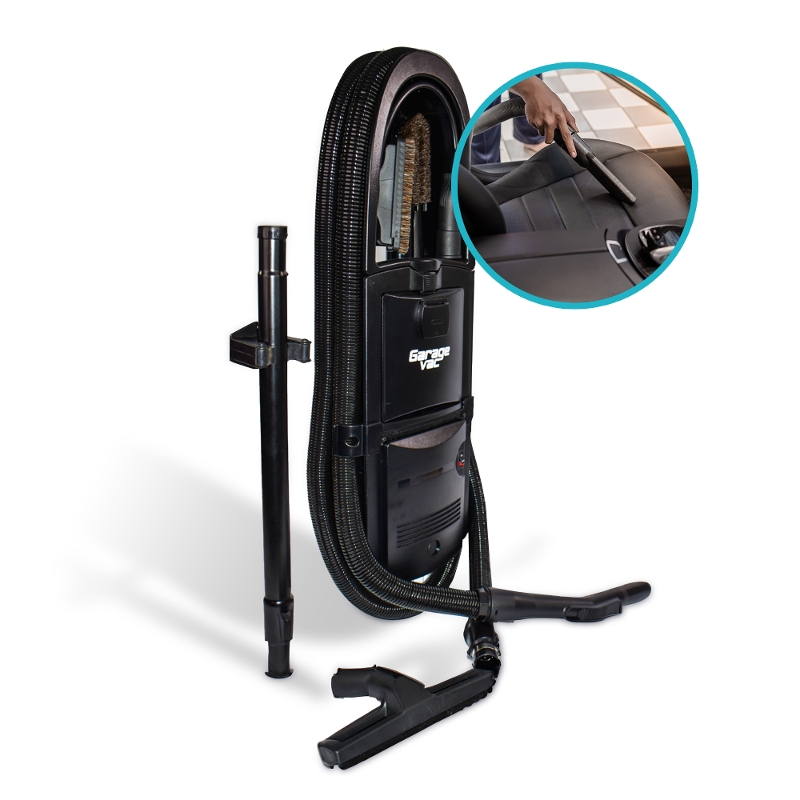
We sell the GH120 two ways: with a switch on the unit, and with a remote on the hose handle. The remote model costs more. Whether a remote control garage vacuum earns that difference depends almost entirely on how far you walk while cleaning.
Here is how to work out which side of that line you are on.
What the remote actually does
On the standard GH120, you switch the unit on at the housing, clean, and switch it off at the housing. On the GH120-E-RC, the control sits on the hose handle, so you start and stop the motor wherever you are standing.
That is the whole feature. It is not more powerful, it does not clean better, and it uses the same bags and filters. What it changes is how many times you walk back to the wall.
Count your trips back to the switch
Here is a test worth doing before you buy. Next time you clean the garage, count how often you would have turned the motor off if it were free to do so.
Most people are surprised. You stop to move a bin. You stop to pick up a bolt that would damage the vacuum, to swap tools, or to answer the door. On a full garage clean, ten to fifteen stops is typical. With a wall switch, every one of those either means a walk or means leaving the motor running.
Leaving it running is the real cost
Running the motor while you are not vacuuming wastes electricity. It also adds noise to a space you are trying to work in. Worse, it puts hours on a motor for no benefit. Over years, that is the argument for the remote in a nutshell.
When the remote is clearly worth it
- You clean vehicle interiors, where you constantly reposition and pause.
- Your garage is deep, or the unit is mounted at the far end from where you work.
- You use the vacuum for short, frequent jobs rather than one long session.
- You have mobility limitations that make repeated walking back and forth a real cost.
Car interiors make the strongest case. Detailing a car means dozens of short bursts. Walking to a wall between each one creates exactly the friction that makes people stop bothering.
When it is not worth it
Skip it if your garage is small, or if the unit mounts within a few steps of where you clean. Skip it too if you vacuum in one long uninterrupted pass. Spend the difference on a better tool kit instead.
The same applies if the vacuum is mostly for a workshop bench rather than for floors and vehicles. In that use, you are standing near the unit anyway.
What you get either way
Each model is a self-contained wall unit. Each ships with a 35+ ft stretch hose. They cover spaces up to about 1,500 sq ft and take the same Y08-5 bag. Each carries a two-year warranty. We list both with UL, and you should check certification on any appliance you leave plugged in permanently. Look for the UL mark.
Neither model takes a VacPort or inlet valves, because the inlet sits in the housing itself. Our piped systems handle that job instead.
The remote handle is a serviceable part
One practical note. We stock the remote handle and the receiver board as replacement parts. So a dropped handle means a part order rather than a new vacuum. We also stock the remote-compatible stretch hose.
There is a matching tool kit with a remote-control handle if you want a spare set of tools on the same system.
Questions about the remote model
Does the remote need batteries?
The control lives on the hose handle and talks to a receiver in the unit. We stock the handle and the receiver board, so a fault in either means a part order rather than a new vacuum.
Does it work through a car body?
The control is on the handle you are holding, so you are never relying on line of sight across a garage. That is a practical advantage over remotes mounted elsewhere.
Can I add a remote to a standard unit later?
The two models differ inside, not just at the handle. So treat this as a purchase decision rather than an upgrade path. If the remote appeals at all, buying it now costs less than changing your mind later.
Is there a remote tool kit?
Yes. We build a kit around a remote-control handle if you want a second set of tools on the same system, and we sell the remote-compatible stretch hose on its own.
Does the remote affect suction?
No. Both models use the same motor, the same bag, and the same filters. The only difference is where the on/off control sits.
Our recommendation
If cars are part of the job, buy the remote model. If the vacuum is for floors, benches and the occasional cleanup, save the money. A remote control garage vacuum is a convenience feature. Convenience features earn their money exactly when they change how often you reach for the tool.
Compare both on our garage vacuums page, or read how to choose a garage vacuum if you are still deciding on the wider setup.