
Blog
How to Clean a Garage Floor Without Making a Dust Cloud

A push broom feels like the obvious tool for a concrete floor. It is also the reason the garage smells dusty for two days afterwards. Sweeping does a good job on leaves and gravel and a poor job on everything smaller, because most of the fine material simply becomes airborne and settles again once you leave. Learning how to clean a garage floor properly is mostly a matter of doing the steps in the right order.
Here is the sequence we use, and why the order matters.
Why sweeping alone works against you
Concrete sheds a fine dust continuously, and tires bring in more. When a broom lifts that material, the coarse fraction moves where you want it and the fine fraction goes into the air. It stays suspended for a long time and then lands on everything, including the car you just washed.
There is a health angle too. Concrete and masonry dust contains crystalline silica, which OSHA treats as a respiratory hazard. Nobody is suggesting a Saturday tidy-up equals an industrial exposure, but it is a good reason to capture the dust rather than stir it.
Step one: clear the large items first
Move bikes, bins, and anything on wheels out or to one side. Then pick up the genuinely large debris by hand. Bolts, offcuts, and stones will damage a vacuum and are quicker to lift than to chase.
Work the perimeter last, because that is where everything migrates.
Step two: go top down
Do shelves, sills, the garage door track, and the tops of cabinets before the floor. Everything you disturb up there lands down here, so cleaning the floor first guarantees you do it twice.
A dust brush on a wand handles this quickly, and a long hose means you are not carrying a machine up a step ladder.
Step three: vacuum, do not sweep
This is the step that changes the result. A vacuum with real airflow lifts the fine fraction into a sealed bag instead of into the room. Work in overlapping passes, in one direction, and go slower than feels necessary. Speed is what leaves the fine layer behind.
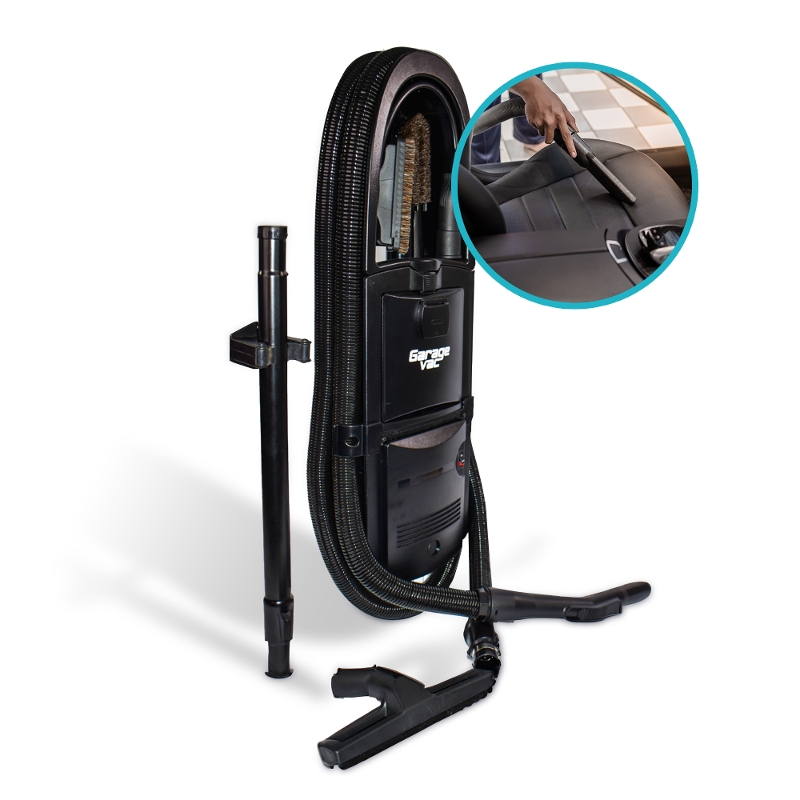
Reach is what makes this practical. Our GarageVac GH120 ships with a 35+ ft stretch hose, so a standard two-car bay is covered from a single mounting point with no cord to move. Because the unit is bagged, emptying it later does not undo the work.
Get the corners and the door track
Use a crevice tool along the wall line and inside the garage door track. Those two places hold more grit than the middle of the floor, and grit in the track is what makes the door noisy.
Step four: deal with oil and stains separately
Never put a dry vacuum on liquid. For fresh oil, cover it with cat litter or a dedicated absorbent, leave it an hour, then sweep the absorbent up and vacuum the residue once the floor is dry.
For older stains, a degreaser and a stiff brush do more than any vacuum will. Let the floor dry completely before the final pass.
Step five: mop only if the floor is sealed
Sealed or epoxy-coated concrete takes a damp mop well. Bare concrete mostly absorbs the water and pushes dust into the pores, so a thorough vacuum is usually the better finish.
If you do mop, do it after vacuuming, never instead of it. Mopping over loose fines makes a slurry that dries back into the surface.
How often to do it
For most households, a full clean twice a year plus a quick vacuum monthly keeps a garage in good shape. If you park on salted roads in winter, add a pass at the end of the season, because salt residue attacks concrete and anything metal stored at floor level.
Whichever schedule you keep, change the bag before it looks full. Suction drops long before the bag fills, which is covered in our guide to how often to change a central vacuum bag.
Garage floor questions
How do I stop tracking dust into the house?
A mat at the internal door catches most of it, and vacuuming the mat itself weekly matters more than the mat’s quality. Cleaning the strip of floor immediately outside that door is the second highest-value habit.
Will sealing the floor help?
Considerably. Bare concrete sheds fine dust continuously, and a sealer or epoxy coating largely stops that at source. It also makes damp mopping viable, which it is not on bare concrete.
What is the fastest way to do the door track?
A crevice tool along the full length, then a damp cloth. Grit in the track is what makes a garage door noisy and what wears the rollers, so it is worth doing more often than the floor.
Can I vacuum up road salt?
Dry salt, yes. Salt slush, no, because it is liquid. Let the floor dry, then vacuum the residue. Salt left on concrete over a winter attacks the surface and anything metal stored at floor level.
The short version
Clear, then top down, then vacuum slowly with a long hose, then treat stains, then mop only if sealed. Done in that order, a garage floor comes up clean and stays clean, and the dust ends up in a bag instead of in the air.
If you are still working off a broom and a shop vac, our comparison of wall-mounted versus portable garage vacuums covers what changes when the hose comes to you instead.