
Blog
How Often Should You Change a Central Vacuum Bag?

Almost every suction complaint we take on the phone ends the same way. The bag is full, or the filter behind it is. Owners tend to wait until the vacuum stops working before they change a central vacuum bag, and by then it has been working badly for weeks.
Here is a simpler rule, and the reasoning behind it.
The short answer
For an average home, change the bag every three to four months. For a garage, a workshop, or a house with pets and kids, change it every six to eight weeks. Then change the motor filter after every fifth bag.
That last part is why our bag packs ship five bags and one motor filter together. The pack is the schedule.
Why a bag hurts you before it looks full
A vacuum bag is a filter, not a bucket. Air has to pass through the paper to carry debris in. As fine dust packs into the fibers, the pores close and airflow drops, even though most of the bag still looks empty.
This is why a bag that appears half full can already have cost you a third of your suction. The visible debris in the bottom is not the problem. The invisible layer coating the walls is.
The signs to watch for
- The floor tool grabs the carpet harder than it used to, then releases suddenly.
- The motor note rises in pitch, because it is pulling against a restriction.
- Fine dust gets left behind on hard floors while larger debris still lifts.
- The unit runs warmer than usual to the touch.
Any one of those is a signal to change a central vacuum bag before you troubleshoot anything else. It costs a few dollars and rules out the most likely cause in two minutes.
Match the bag to the model, not the shelf
Bags are model-specific, and several of ours look similar in the box. Getting this wrong is the second most common support call we take.
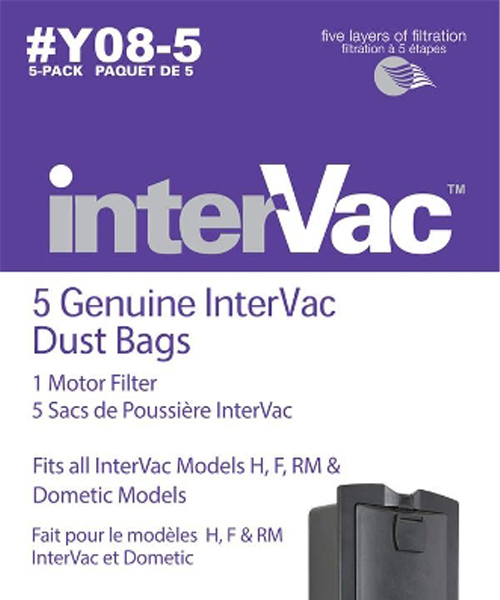
- Y08-5 fits the GarageVac, the H-120-E and the RM family.
- Y20-3 fits the InterVac Pro, the IVD660 and the CondoVac.
- Y10-5 fits the CS-6 and CS-8, and it has a single opening.
- Y11-5 fits the CS-9, CS-10 and CSRM, and it has a double opening.
The Y10 and Y11 are the pair to watch. Side by side on a bench they are nearly identical, and a single-opening bag fitted to a double-opening unit will leak dust straight into the motor housing.
The motor filter does the job the bag cannot
Some fine particles pass through any bag. The motor filter catches them before they reach the impeller. When it clogs, the motor pulls harder, runs hotter, and wears faster.
Change it after every fifth bag. It takes about thirty seconds and it is the cheapest insurance you will ever buy for a vacuum motor. Our motor filters are model-specific too: the Y21 covers the GarageVac and RM family, the Y22 covers the RoadVac CS line, and the Y25 covers the InterVac Pro.
What about the exhaust filter?
Home and garage units also carry an exhaust filter, which cleans the air on its way back out. Replace it once a year in normal use. The RoadVac CS line is deliberately different: it uses no exhaust filter, and instead offers an overboard exhaust option that vents outside the living space entirely.
Why genuine bags matter here
We are not neutral on this, so take it for what it is worth, but the reasoning is straightforward. Aftermarket bags are usually thinner and cut slightly differently. A thin bag clogs sooner, so you change it more often. A bag that seats imperfectly lets dust bypass the seal and reach the motor.
There is also a warranty consequence. Using non-genuine bags or filters voids the vacuum warranty on our systems, which is a bad trade for a few dollars a pack. Our full bag range sits on the replacement dust bags page, and there is a bag subscription if you would rather not think about it at all.
Questions about bag changes
Can I shake out a bag and reuse it?
No. The restriction is fine dust embedded in the paper fibres, and shaking does not remove it. You also release that dust straight back into the room, which is the thing the bag existed to prevent.
Why did suction not improve after a new bag?
The motor filter behind it is the usual answer, especially if you have gone several bags without changing one. After that, check the hose for a blockage or a leak, then check that every inlet valve is closed. Working through the checks in order saves a service call.
What fills a bag fastest?
Fine powders. Drywall dust, plaster, fireplace ash and cement dust all pass into the fibres rather than sitting in the bottom, so they choke a bag in a fraction of the usual time. Guidance from the EPA on indoor air is a good reminder of why those particles matter beyond the vacuum.
Is there a bag-full indicator?
Not on our systems, and we would treat one on any vacuum with caution. Most indicators respond to pressure, which only rises once the bag is already restricting airflow. A calendar reminder beats a warning light.
Build the habit around something you already do
The owners who never have a suction problem all do the same thing. They tie the bag change to something on the calendar: the season change, the oil change, the day the clocks move. Pick any recurring event and change the bag then.
If you have changed the bag and the filter and suction is still down, the problem is further along the system. Our guide to clearing central vacuum pipe blockages is the next place to look.