
Blog
Looking After a Vacuum Stretch Hose So It Lasts

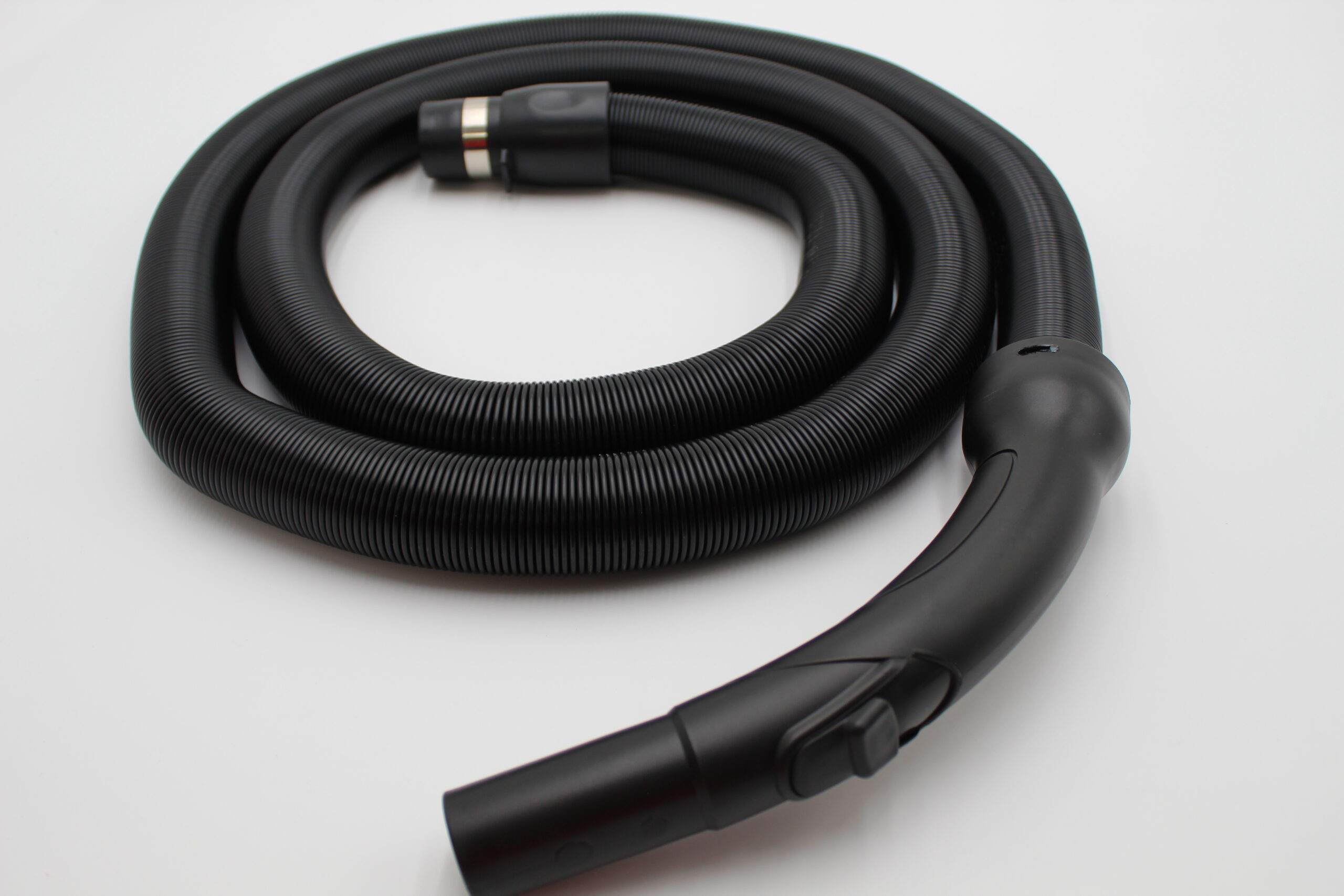
The hose is the part of any central vacuum you actually touch, and it is the part most likely to need replacing first. That is not a design flaw. It is a consequence of being stretched, dragged across concrete, and wedged under a car seat several hundred times a year. A vacuum stretch hose will last a very long time if you avoid three specific habits.
Here is what kills them and what to do instead.
Failures happen at the cuffs
Open up a hose that has died and the damage is almost never in the middle. It is at the two ends, where the flexible carcass meets the rigid cuff. That junction takes every twist, every tug, and every time the hose is pulled around a corner at an angle.
So the single most useful habit is to pull from the body of the hose rather than from the cuff. When you need more reach, walk the hose out instead of yanking it. It sounds fussy. It roughly doubles service life.
Never pull the hose to move the machine
On a portable unit, dragging the canister by the hose puts the entire weight of the machine on that cuff joint. On a wall-mounted system it is worse, because the wall does not move and something has to give.
Storage: coiled loosely, not stretched
A stretch hose holds its recoil because the material has memory. Leave it under tension for weeks and that memory fades, which is why a hose left stretched across a garage floor never quite retracts properly again.
Coil it in wide loops, roughly two feet across, and hang it on a hook or over a bracket. Avoid tight coils, sharp hooks, and anything that kinks a single spot repeatedly. If your unit retracts the hose into the housing, let it retract fully rather than leaving the last few feet out.
Heat, sun and cold
Ultraviolet light and heat both harden the carcass over time. A hose left in direct sun through a garage window, or coiled on a hot engine bay, ages faster than one hanging in shade.
Cold matters too. A hose that has sat at freezing temperatures is stiffer and more brittle, so let it come up to room temperature before stretching it hard. In an unheated garage in January, that means running the unit for a minute before you start pulling.
Clearing a blockage without damaging the hose
When something lodges in a hose, the instinct is to force a broom handle down it. That is how carcasses get punctured from the inside.
Instead, disconnect the hose and let gravity help. Hang it vertically and the obstruction will often drop out. If it does not, feed a length of soft, flexible line through rather than anything rigid with an edge. Our guide to clearing central vacuum blockages covers the pipe side of the same problem.
Check for leaks with your hand
A pinhole in a hose costs you suction everywhere. To find one, run the unit, block the hose end, and run your other hand slowly along the length. You will feel air escaping before you can see the hole. Tape is a temporary fix at best; a leaking hose should be replaced.
Cleaning the inside
Hoses pick up odours, particularly in a home with pets or after a spill that was almost dry. Do not put a vacuum hose through a washing machine or soak it.
Instead, vacuum a small handful of baking soda through it, then leave the hose hanging with both ends open for a day. If something genuinely wet went through, hang it vertically to drain and give it two full days before use. A damp hose in storage grows exactly what you would expect.
Inspect the fittings once a year
Check both cuffs for cracks, check the handle for play, and on a remote-control handle check the contacts and the cable entry. Any electrical accessory with a damaged cord or cracked housing should be taken out of service, which is the standard line the Consumer Product Safety Commission gives for household appliances generally.
Our hoses and handles are stocked as replacement parts, including the remote-control handle assemblies, so a worn cuff does not mean a new system.
Hose questions
How long should a hose last?
In household use, many years. In a garage where it is dragged across concrete and pulled around a car several times a week, expect a shorter life and inspect the cuffs annually. Pulling from the body rather than the cuff is the single habit that extends it most.
Can I repair a split hose?
Tape is a temporary measure at best, and a taped hose leaks air along its whole length once the adhesive moves. A hose with a hole should be replaced, because you are otherwise losing suction on every job.
Why does my hose not retract fully?
Usually because it has been stored stretched. The material has memory, and weeks under tension flattens it. Coiling loosely and letting a retracting unit take the last few feet in will preserve what recoil is left.
Is a longer hose always better?
No. Every extra foot costs a little airflow, so a very long hose trades suction for reach. Extensions are best used occasionally rather than left permanently attached.
Can I use a hose from another brand?
If the cuff is 32mm, usually yes. Measure rather than assume, since 35mm systems from other manufacturers will not fit and forcing a fitting damages both parts.
Matching a replacement hose
All our tool fittings are 32mm, and they work across every system we build. That also means our hoses and tools fit 32mm inlets from other brands such as Beam and Husky. They do not fit 35mm systems from Shark, Dyson or Miele.
We advertise our hose as 35+ ft deliberately. The plus is there because it stretches further than the number, and we would rather you measure it and be pleased than measure it and feel short-changed. Browse hoses and tools in our accessory kits range.