
Blog
Tiny Home Vacuum Systems: Cleaning a Small Space Properly

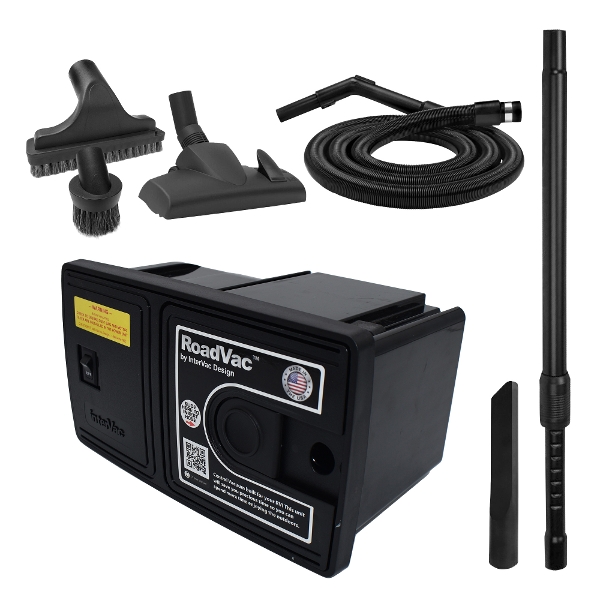
Cleaning a tiny home is quick. Storing the thing you clean it with is not. That is the whole problem in one sentence, and it is why a tiny home vacuum has to be chosen on footprint and exhaust before anyone talks about suction.
Here is how we would approach it, whether the house is on a foundation or on a trailer.
Storage is the first constraint
A stick vacuum needs a full-height slot, which in a tiny home means giving up a wardrobe bay or a pantry column. An upright is worse. Even a compact canister takes floor space that is already doing three jobs.
A built-in unit mounts once, inside a cabinet or under a bench, and gives the floor back permanently. Only the hose and a few tools need storing, and those fit in a mesh bag on a hook. In a house measured in single-digit square metres of storage, that is the deciding factor.
Exhaust has nowhere to go
This is the part most people do not think about until they have vacuumed once. In a 300 sq ft space, whatever the vacuum blows out stays with you. A bagless canister makes it worse, because emptying it releases another cloud of the same fine dust in the same small room.
Our RoadVac CS line is designed around this. It uses no exhaust filter by design, and instead offers an overboard exhaust option that vents the air outside the living space entirely. Venting beats filtering when the room is that small, and it is a genuine advantage over any portable machine.
Bagged, always
Whatever you choose, choose bagged. A sealed multi-layer bag goes from the unit to the bin without ever being opened. In a space this size that matters more than it does in a house.
Power budget
Tiny homes run tight electrical systems, and vacuums draw real current. If you are on a 20-amp circuit shared with a kettle, a heater and a laptop, an inrush from a vacuum motor can trip you out.
Our CS-6 was built for exactly this situation. It includes power management that prevents the unit from overloading a 20-amp circuit, and it is hardwired rather than plugged in. If your build has a constrained supply, that is the model to look at. The rest of the line runs on a standard 120V supply, with 240V single phase available on request.
Mounting: self-contained or remote
Self-contained units have the inlet built into the housing, so the hose plugs into the machine. The CS8 is the straightforward choice here, and it needs no pipe and no wiring beyond power.
Remote-mounted units put the motor in a bay or a cavity and run pipe to an inlet in the living area. The CSRM does this, and it accepts inlet valves and VacPorts. If your build has an unused void under the floor or behind a wet wall, remote mounting keeps the motor noise out of a room you cannot walk away from.
One note worth repeating: self-contained models take no VacPort and no inlet valves. That capability belongs to the piped units only.
Coverage and what fits the job
The whole RoadVac line is rated for spaces up to 900 sq ft, which covers essentially any tiny home with a wide margin. You are not short of capacity here. You are short of room, which is why the decision runs on mounting rather than on power.
If your build follows the residential tiny-house appendix, the code text is published by the International Code Council, and it is worth checking before you cut into a wall for pipe.
Tools for a small space
Skip the full-size floor tool. In a tiny home the work is upholstery, stairs to a loft, window tracks, and the strip of floor beside the door. A crevice tool, a dust brush and an upholstery brush cover almost everything.
All our tool kits use a 32mm fitting and work across every system we build, so you are not locked into model-specific accessories. They also fit 32mm inlets from other brands if you are replacing an older unit.
Tiny home questions
Will a built-in unit survive being towed?
Yes, and that is part of the point. A bolted-down unit has nothing to work loose, unlike a portable that has to be strapped or wedged before every move.
Where do people usually mount them?
Under a bench seat, in the base of a wardrobe, or in an exterior access bay if the build has one. The two requirements are bag access without unloading the space and a hose route that reaches the loft.
Can I run one on solar?
Possible with a substantial system, but the start-up surge is the limiting factor rather than the running draw. Size the inverter for the surge and expect a real hit on the bank even for a short clean.
How do I clean a sleeping loft?
With hose length rather than by carrying anything up a ladder. A 35+ ft hose from a ground-level inlet reaches a loft comfortably, which is the single strongest argument for a built-in unit in a tiny home.
What if my build is on a foundation rather than a trailer?
The same logic applies, minus the road vibration. You gain the option of a permanent overboard exhaust through a wall, which is worth designing in early.
Bags: note the model now
Write your model number inside the cabinet door before you close it up. The CS-6 and CS-8 take the single-opening Y10-5, and the CS-9, CS-10 and CSRM take the double-opening Y11-5. They look almost identical, and the wrong one leaks past the seal.
Compare the range on our RV and compact vacuums page, or send us your floor plan and we will tell you where the unit should go.