
Blog
RV Vacuum Systems Compared: What Actually Works on the Road

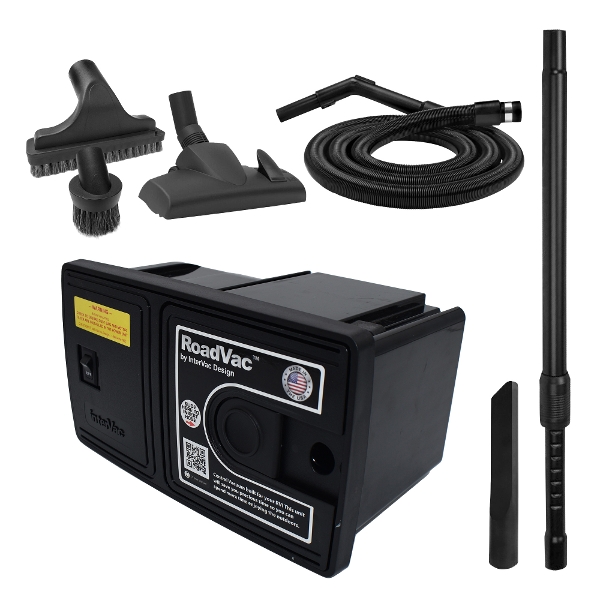
An RV punishes cleaning equipment. Storage is tight, the power budget is tighter, and everything you own has to survive being shaken down a highway. So the vacuum that works beautifully in a house often fails badly in a coach. Choosing an RV vacuum system is really a question of constraints rather than suction.
We build the RoadVac line for exactly this environment. Here is an honest comparison of the options, including the ones we do not sell.
Option one: the handheld
A cordless handheld is cheap, stores in a drawer, and handles crumbs on the dinette. That is the whole case for it, and it is not a bad one for a weekend trailer.
The limits show up quickly though. Runtime is short, the dust cup is tiny, and emptying it inside a small cabin puts most of the fine dust straight back into the air. Handhelds also struggle with the two jobs RV owners actually hate: the carpet at the door and the gap between the slide and the floor.
Option two: the stick vacuum
Stick vacuums promise the best of both worlds. In a coach they usually deliver neither. They take up a full closet bay, they tip over in transit unless you strap them down, and they depend on a lithium-ion battery that lives in an uninsulated box parked in the sun.
That last point matters more than most buyers expect. We wrote about it in the hidden risks of stick vacuums in recreational vehicles. Temperature extremes shorten battery life, and in the worst cases they do considerably more than that.
Option three: a built-in RV vacuum system
A built-in unit mounts once, inside a cabinet or a basement bay, and never moves again. You lose a small amount of storage permanently and gain the floor space a portable machine would have occupied. Because the motor is bolted down, nothing rattles loose on the road.
Our RoadVac line covers six models built around this idea, all rated for spaces up to 900 sq ft. That range covers a travel trailer, a fifth wheel, a Class A coach, a boat interior, or a tiny home.
Self-contained or remote-mounted
The RoadVac line splits in two, and the difference decides your install. The CS8 is self-contained: the hose plugs into the unit itself, so it goes wherever you can reach it. The CSRM is remote-mounted, so the motor hides in a basement bay while the inlet sits somewhere convenient in the living space.
Pick self-contained when you have one obvious cabinet and a simple layout. Pick remote-mounted when you would rather not hear the motor, or when the only spare space is nowhere near where you clean.
Power draw is the constraint nobody plans for
Every RV vacuum system runs on the same limited supply as your air conditioner, microwave, and converter. Some coaches have plenty of headroom on shore power and almost none on a generator.
Our CS-6 addresses this directly with built-in power management, which prevents the vacuum from overloading a 20-amp circuit. If your rig has a tight electrical budget, that model exists for you. The rest of the line runs on a standard 120V supply.
Where the dust ends up
In a house, vacuum exhaust disappears into a large volume of air. In a 300 sq ft coach it does not. This is why the RoadVac line uses no exhaust filter by design and offers an overboard exhaust option instead. The exhaust vents outside the living space entirely, which beats filtering it and breathing the remainder.
Bags matter here too. All six models use a sealed multi-layer bag that you pull out and throw away, so nothing is released back into the cabin. Just be careful which one you order. The CS-6 and CS-8 take the single-opening Y10-5 bag, while the CS-9, CS-10 and CSRM take the double-opening Y11-5. They look nearly identical on a shelf and they are not interchangeable.
Questions RV owners ask us
Will a house vacuum work in a coach?
Physically yes, practically no. A household unit assumes storage you do not have and exhaust volume you do not have. It also assumes the machine sits still, which stops being true at highway speed.
How much storage does a built-in unit cost me?
Roughly the volume of a small suitcase inside a cabinet or a basement bay, and it is permanent. In exchange you get back the floor space and the closet slot a portable would have taken, plus you stop strapping anything down before you drive.
Can I add one to a coach I already own?
Yes, and most of our RV installs are retrofits. A self-contained unit needs a cabinet and a power source. A remote-mounted unit needs a bay for the motor and a short pipe run to an inlet, which is more work but keeps the noise out of the living space.
How often will I be changing bags?
More often than in a house, because sand and grit fill a bag faster than household dust. Every six to eight weeks in regular use is a reasonable expectation. Keep a spare pack in the rig rather than at home.
What we would put in our own coach
For most owners, a remote-mounted unit with one inlet in the main living area and a second near the entry door covers everything. Add a crevice tool and an upholstery brush and you have the whole job handled.
Manufacturers specifying systems for production units should read our note on specifying a central vacuum for RV production. The industry standards RV builders work to are published by the RV Industry Association.
Not sure which model suits your floor plan? Browse the RV vacuums range or send us your layout and we will point you at the right one.