
Blog
What 35+ Feet of Hose Actually Covers in a Two-Car Garage

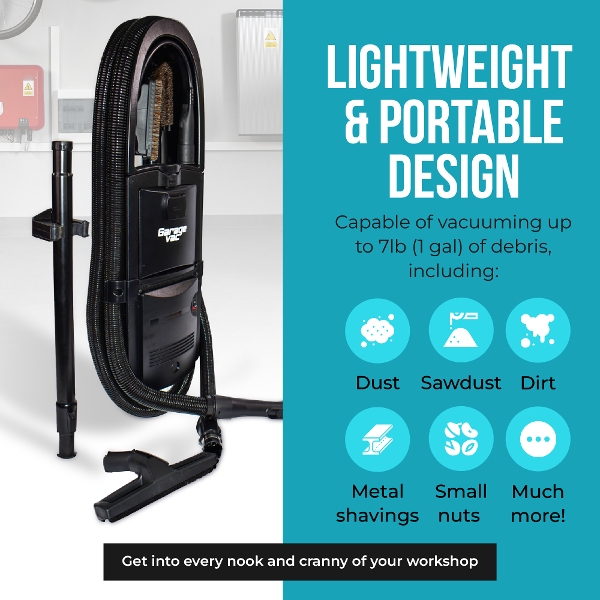
Hose reach is the specification that decides whether a wall-mounted system covers your garage from one point or two. It is also the specification most easily misread, because garage vacuum hose length on paper and usable reach in a garage are different numbers.
Here is the arithmetic, with real garage dimensions.
Standard garage sizes
A typical American two-car garage runs about 20 by 20 feet, with 24 by 24 feet common in newer builds. Three-car garages usually run 30 to 36 feet wide. Those are the figures builders work to, and the National Association of Home Builders publishes the residential norms they come from.
Take a 24 by 24 garage. The longest straight line inside it, corner to opposite corner, is about 34 feet. That is already close to a 35 ft hose before anything gets in the way.
Why straight-line distance is optimistic
A hose does not travel corner to corner. It travels around a parked car, past a bench, and up over a wheel arch to reach a footwell.
In practice, subtract roughly 15 percent from the straight-line figure to get usable reach. A 35 ft hose behaves like about 30 ft of practical coverage in a garage with two cars in it. That is still enough for a 24 by 24 bay from a well-chosen mounting point, but the margin is smaller than the number suggests.
Height eats length too
The unit is mounted at chest height, roughly four feet up. Getting the nozzle to the floor uses that four feet twice over as the hose drops and then rises again through its arc. It is not much, but it counts when you are working at the limit.
Why we advertise 35+ rather than a fixed number
Our hose stretches meaningfully beyond 35 feet. We publish 35+ deliberately, because a customer with a tape measure should never be able to say the hose is shorter than advertised.
The industry convention runs the other way, quoting the most generous number the hose can reach when fully extended. We would rather under-promise and have the extra there when you need it.
What one mounting point genuinely covers
- 20 by 20 garage: comfortably covered from a single mid-wall position, including both vehicles.
- 24 by 24 garage: covered from a well-chosen position, roughly a third of the way in from the door on a side wall.
- 30 ft or wider, or a garage with a workshop bay: usually needs either a second mounting position or a second unit.
Our guide to where to mount a garage vacuum includes a string test that settles this in ten minutes, before you drill anything.
Extending reach without a longer hose
A telescopic wand adds two to three feet of usable reach at the working end and saves bending. That is often all that is missing.
An extension hose is the other option. We stock a 10 ft extension, though be aware that every extra foot of hose costs a little airflow, so it is better as an occasional addition than a permanent one.
When a second unit beats a longer hose
In a deep three-car garage, running 45 feet of hose to the far corner is worse than mounting a second unit there. The airflow loss over that distance is real, and dragging that much hose is the thing that stops people using the vacuum at all.
At $279 for the GH120, a second unit is often the better answer. Both models are self-contained, so a second one needs nothing but a wall and a 120V outlet.
Reach questions
Does a longer hose reduce suction?
Yes, a little, and the loss grows with length. That is why a second unit in a large garage usually beats a very long hose: you keep full performance at both ends rather than compromising at one.
Can I add an extension permanently?
You can, but we would treat an extension as an occasional addition rather than a fixture. If you need the extra length every time, the mounting position is probably wrong.
What about ceiling height?
A high garage ceiling does not change floor coverage, but it does affect reaching shelving and rafters. A telescopic wand adds two to three feet at the working end and is the cheaper answer.
How do I measure my own garage properly?
Measure wall to wall, then measure with the cars parked as they normally are. The second figure is the one that matters, and it is usually the one people never take.
Is the hose the same on both models?
Both ship with a 35+ ft stretch hose. The remote-control model uses a remote-compatible version of it, which is stocked separately as a replacement part.
One last practical point
Hose reach is worth testing with the cars where they normally sit, not with an empty garage. An empty bay flatters every mounting position, and the position that works on a Saturday morning may not work on a weekday evening with both vehicles in.
Do the string test twice, once empty and once loaded, and mount for the loaded case.
Checking your own garage
Cut a piece of string to 30 feet, which is the realistic working figure. Pin it at each candidate mounting position and check it reaches three targets: the far floor corner, the rear footwell of the furthest vehicle, and both ends of the garage door track.
If one position hits all three, that is your spot. If none does, plan for two. Our guide to choosing a garage vacuum covers the rest of the decision.