
Blog
GarageVac vs Giraffe Tools: An Honest Comparison

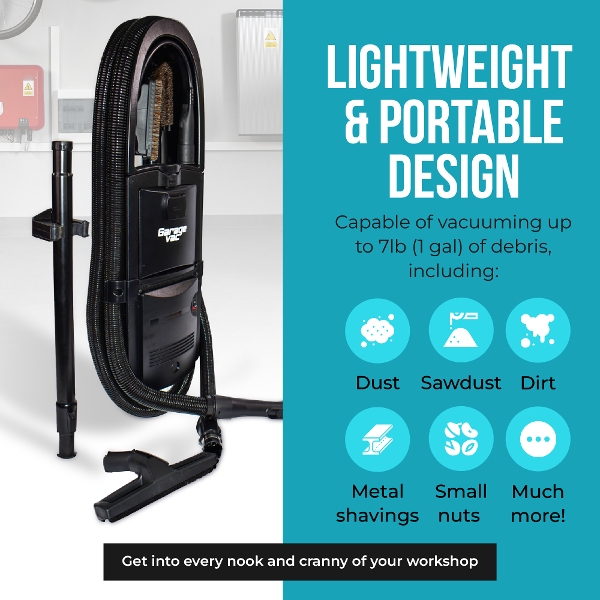
We build the GarageVac, so treat this as an interested opinion rather than a neutral review. That said, we would rather set out the real differences than pretend there are no reasons to buy the other one. Anyone weighing GarageVac vs Giraffe Tools is choosing between two genuinely different design philosophies, and the right answer depends on what you clean.
Here is the comparison, including where Giraffe wins.
Where Giraffe wins: wet pickup
Giraffe’s retractable model is a wet/dry machine. Ours is not, and no dry central vacuum should ever be used on liquid. If you regularly deal with spills, melting snow off a truck, or a floor drain that backs up, that is a real advantage and it should probably decide your purchase.
We would rather say that plainly than have someone buy a GarageVac and discover the limitation in February.
Hose reach
Giraffe publishes a 30 ft retractable hose. The GarageVac GH120 ships with a 35+ ft stretch hose, and we advertise it conservatively so nobody with a tape measure feels short-changed.
Five feet sounds trivial until you are reaching the far side of a second vehicle from a single mount point. In a standard two-car garage, that gap is often the difference between one mounting position and two.
How each brand measures suction
This is where comparison gets genuinely difficult, because the two brands publish different units. Giraffe quotes 20 kPa and 1200 W on its retractable model. We quote air watts.
Those numbers are not interchangeable, and the difference is worth understanding.
Input watts are not suction
A wattage figure such as 1200 W tells you how much electricity the motor consumes. It says nothing about how much of that energy reaches the end of the hose. Two motors drawing identical power can deliver very different results.
kPa measures lift, not airflow
Kilopascals measure sealed suction, meaning how hard the machine pulls when you block the hose completely. That is one useful property. It does not tell you how much air the machine moves, and airflow is what actually carries sawdust and grass clippings down a hose.
Air watts combines both into a single working figure, measured to the ASTM F558 standard. Our guide to air watts explains the method. When you compare any two garage vacuums, insist on the same unit for both, or you are not comparing anything.
Bagged or bagless
Wet/dry machines are generally bagless, which is what makes wet pickup possible. The trade-off arrives at emptying time. Tipping a canister of fine dust in a closed garage puts a good share of it straight back into the air.
The GarageVac is bagged. You open the door, pull a sealed five-layer bag, and drop it in the trash. Behind it sit a motor filter and an exhaust filter. It is a more expensive way to run a vacuum, and it is a cleaner one.
Parts, service and the five-year question
This is the part buyers underrate. Ask what happens when the motor fails in year four.
We stock motors, circuit boards, switches, cords, hoses, brackets, doors and housing parts for every system we have ever sold, including models that no longer have a product page. The GH120 carries a two-year warranty on the unit and 30 days on accessories. Our housings are molded and the units assembled at our own plant in Palm City, Florida, which is why the parts shelf stays stocked.
Price
The GH120 is $279. The remote-control model, the GH120-E-RC, is $361.08 and lets you start and stop the unit from the hose handle. Giraffe’s retractable model also offers a remote and typically sits in a similar bracket depending on where you buy it.
Prices move, so check both on the day. The running cost is the number worth modelling: bags and filters for us, replacement filters and the eventual canister-seal wear for a bagless machine.
Questions people ask when comparing the two
Which is quieter?
Neither brand publishes a comparable sound figure, so treat any claim with caution. What we can say is that a wall-mounted motor above head height is less intrusive than a floor unit beside you, and that both brands mount on the wall.
Do the tools interchange?
Check the cuff diameter before assuming. Our tools use a 32mm fitting, which also suits 32mm inlets from brands such as Beam and Husky, but not 35mm systems. Measuring the hose end is the only reliable test.
Which is easier to install?
Both are wall units needing anchors and an outlet, so the difference is small. A dry system such as ours has no drain to consider, which slightly simplifies placement.
What happens to a bagless canister over time?
The seals and the filter media are the wear items, and both are cheaper to replace than a bag habit is to maintain. The trade-off is what happens at emptying time, when a bagless machine releases fine dust into the space you are standing in.
Should I read reviews?
Yes, but read the two-star ones. Five-star reviews tell you the box arrived. Two-star reviews tell you what broke in year two, which is the information that actually separates these machines.
How we would decide
Choose Giraffe if wet pickup is a regular part of your work. Choose the GarageVac if your garage is a dry environment, you want the fine dust captured rather than recirculated, and you care about being able to buy a replacement motor in 2031.
If you want to compare against the rest of the field, our wider garage vacuum comparison covers Bissell and shop vacs, and the full range sits on our garage vacuums page.