
Blog
What RV Owners Get Wrong About Onboard Vacuums

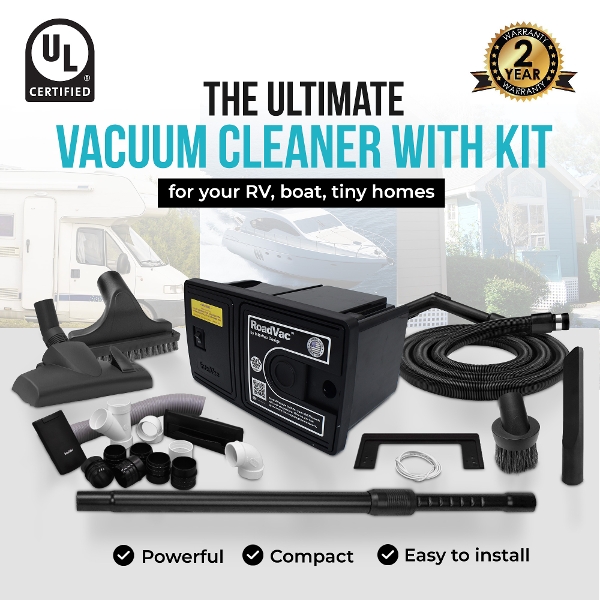
We take enough support calls from coach owners to see the same handful of problems repeatedly. Almost none of them are faults. They are decisions made at install time, or assumptions carried over from a house, that make an RV onboard vacuum less useful than it should be.
Here are the five that come up most, and what to do instead.
Mistake one: buying the wrong bag
This is the most common call we take, by a wide margin. Our CS line uses two different bags that look almost identical on a shelf.
- CS-6 and CS-8 take the Y10-5, single opening.
- CS-9, CS-10, CSRM and CSRM-RC take the Y11-5, double opening.
Fit a single-opening bag to a double-opening unit and dust bypasses the seal, heads straight for the motor filter, and clogs it in weeks. The fix costs nothing: write your model number inside the access door today, and order from that rather than from memory.
Mistake two: mounting where there is space, not where it works
The instinct is to put the unit in whatever bay is empty. That is how people end up with a vacuum behind the spare tyre, or one that requires unloading a basement bay to change a bag.
Choose the mounting position for two things: bag access and hose reach. If you cannot open the door and pull a bag out in under a minute, you will not do it on schedule. And if the hose does not reach the far end of the coach, you have built in a reason not to use it.
Remote-mounted solves both problems
A remote-mounted unit such as the CSRM puts the motor in a bay and the inlet in the living area. The motor noise stays behind a bulkhead, and the inlet goes exactly where you clean. Our comparison of CS8 vs CSRM covers which suits which layout.
Mistake three: assuming a VacPort works on any model
A VacPort is an automatic dustpan built into a toe kick, and it is genuinely useful in a coach with a hard floor. But it only works on piped systems.
Self-contained models, including the CS-6 and CS-8, take no VacPort, no inlet valves and no pipe fittings. Not as an upgrade, not with an adapter. If a VacPort is on your wish list, that decision has to be made before you choose the unit.
Mistake four: ignoring the power budget
An RV runs everything off one limited supply, and it looks different on shore power than it does on a generator. A vacuum drawing full current at the same moment as the air conditioner is a nuisance trip waiting to happen.
Our CS-6 exists for this. It includes power management that prevents the unit from overloading a 20-amp circuit, and it is hardwired rather than plugged in. If your rig is electrically tight, that model is the answer rather than a compromise. RV electrical and safety requirements are set out in the standards published by the NFPA, and any hardwired install should follow them.
Mistake five: treating exhaust like a house
In a house, vacuum exhaust disappears into a large volume of air. In a coach it does not, and this is why our CS line carries no exhaust filter by design.
Instead the line offers an overboard exhaust option that vents outside the living space entirely. Owners who skip that option and then wonder why the cabin feels dusty after vacuuming have found the answer. Venting beats filtering when the room is that small.
One bonus: the remote-control footnote
On the CSRM-RC, the inlet valve will not switch the vacuum on or off. You start it from the pistol grip on the handle. A VacPort will start it if it has been wired correctly.
That single line prevents a support call, and it is easy to miss in the manual. If you have an RC model and think the inlet is faulty, check this first.
More questions from coach owners
My inlet does not start the vacuum. Is the motor dead?
Check the model first. On a CSRM-RC, the inlet valve is not meant to switch the unit on at all; you start it from the pistol grip. On other models, the contacts inside the inlet are the usual culprit rather than the power unit.
Can I use household tools on an RV unit?
Yes. Every tool we make uses a 32mm fitting and works across the whole range. Only bags and filters are model-specific.
How do I stop the unit rattling on the road?
Mount into structure rather than into a cabinet panel alone, and check the fixings once a season. A unit that has worked loose will make itself heard long before it fails.
Should I remove the bag for winter storage?
Change it before layup rather than removing it. A full bag left over a winter holds moisture and odour, and a fresh one costs a few dollars. Leave the unit dry and closed.
What is the most common failure you see?
A motor filter that was never changed, followed by grit reaching the motor. It is entirely preventable, and it is why every 5-pack ships with a filter.
Getting it right from the start
Choose the mounting position for bag access, match the bag to the model, confirm VacPort compatibility before you buy accessories, size the electrical load honestly, and take the overboard exhaust option. Do those five things and the system disappears into the coach, which is exactly what you want.
Compare the line on our RV vacuums page, and manufacturers speccing for production should read specifying a central vacuum for RV production.