
Blog
How to Choose a Garage Vacuum: A Practical Buyer’s Guide

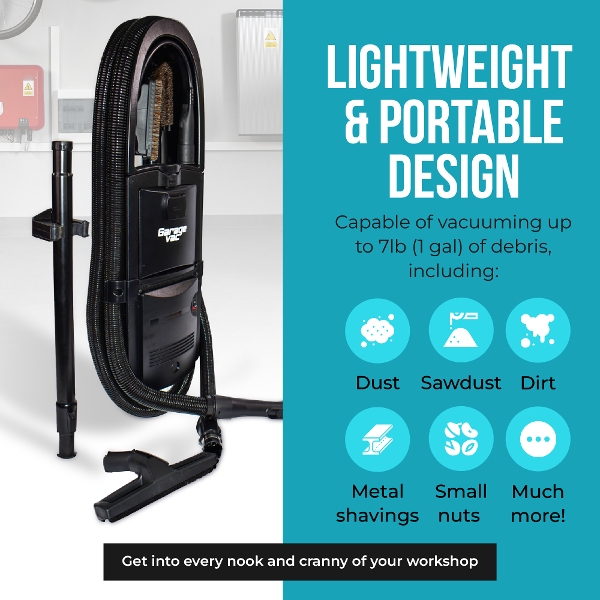
A garage collects everything. Sawdust, grass clippings, road salt, dog hair, and whatever falls out of the car on a Monday morning. The vacuum you keep out there works harder than anything you run indoors, and it usually gets less care. So if you are working out how to choose a garage vacuum, start with the jobs you actually do rather than the number printed on the box.
We build wall-mounted garage vacuum systems at our plant in Palm City, Florida. Below is the same checklist we would use ourselves.
Start with reach, not horsepower
Reach decides whether you use the vacuum at all. A canister you have to drag around the car, unplug, and re-plug on the other side stops getting used by about week three. That is the real reason most garage vacuums end up under a bench.
Measure the longest run you need. In a two-car garage that is usually the far corner to the back seat of the second vehicle. Then add a few feet for slack. Our GarageVac GH120 ships with a 35+ ft stretch hose, which covers a standard two-car bay from a single mounting point. Because the hose retracts back into the unit, you are not coiling anything afterwards.
Judge suction by air watts, not horsepower
Horsepower ratings on consumer vacuums are close to meaningless. Manufacturers quote peak motor figures that the machine never reaches in normal use, and the number tells you nothing about airflow at the end of a hose. We wrote about that in detail in why horsepower is not relevant for vacuum cleaners.
Air watts is the better measure, because it combines suction and airflow into one figure at the working end. The ASTM F558 standard defines how it is measured. When you compare two units, ask for air watts. If a seller cannot produce the number, that is an answer in itself.
Airflow moves debris, suction lifts it
Both matter, but they do different jobs. High suction with poor airflow will pick up a bolt and then stall on sawdust. Good airflow carries the light material down the hose. A garage sees far more of the light material, so airflow deserves the weight in your decision. Our guide to air watts explains how the two combine.
Decide how it mounts
This is where garage vacuums split into two camps. A portable unit sits on the floor, takes up space, and moves when you need the floor back. A wall-mounted unit stays put and gives the floor back permanently.
Wall mounting has a second advantage that owners notice later. The unit sits above the dirt, so it does not get kicked, flooded in a wet-floor cleanup, or buried behind a lawnmower. Mount it near an outlet at roughly chest height, and the hose does the travelling instead of the machine. Installation on a GarageVac takes minutes with two anchors and a standard 120V outlet.
Look at what it costs to keep running
Purchase price is the smaller half of the decision. Bags, filters, and hoses are the half you pay every year. Therefore ask three questions before you buy.
- What does a bag cost, and how many come in a pack?
- Does the pack include a motor filter?
- Can you still buy parts for this model in five years?
Our Y08-5 bag packs include five bags and a motor filter, because the filter should be changed after every five bags. We also stock replacement motors, boards, switches, cords, and housing parts for every system we have ever sold. That matters more than it sounds. Plenty of garage vacuums are effectively disposable once the maker drops the model.
Check the filtration and where the exhaust goes
A garage vacuum blows its exhaust into the space you are standing in. Fine dust that passes through a thin bag comes straight back at you. Bagless units are worse in this respect, because emptying the canister releases another cloud of the same dust.
Look for a multi-layer bag and a separate motor filter. Our systems use a five-layer fiber bag plus a motor filter and an exhaust filter, which keeps the fine material captured rather than recirculated. When the bag fills, you pull it out and drop it in the trash without opening a dust cup.
Match the system to the space
Coverage ratings are a useful sanity check. A GarageVac is rated for spaces up to about 1,500 sq ft, which covers most two- and three-car garages plus a workshop corner. If you are cleaning a larger shop, or you want the same system running through a whole house, a piped central vacuum such as the InterVac Pro is the better fit, since it is rated up to 3,000 sq ft.
You can also browse the full range on our garage vacuums page if you want to compare models side by side.
Common questions about choosing a garage vacuum
Do I need a wet/dry machine?
Only if you regularly deal with liquid. Melting snow off a truck, a spill, or a floor drain that backs up all call for a wet/dry unit, and no dry central system should ever be used on liquid. If your garage is a dry environment, a dry system captures fine dust far better and is cleaner to empty.
How much noise should I expect?
All vacuums are audible. What changes is where the motor sits. A floor unit puts the noise at ankle height beside you, while a wall unit puts it above head height and directs exhaust away from where you are working. In a closed garage that difference is noticeable within a minute.
Can one vacuum cover the garage and the house?
Sometimes, but it is often the wrong answer. Extending pipe from a house unit across a breezeway costs airflow and means a blockage in one zone takes the other offline. A dedicated garage unit plus a separate house system is usually cheaper and always more reliable.
What should I not vacuum in a garage?
Liquid, fireplace or barbecue ash, drywall dust in quantity, and anything still warm. Ash and drywall dust pass straight through a bag and coat the motor filter within minutes, which is an expensive way to save a dustpan.
A short checklist
To summarize, here is how to choose a garage vacuum without regretting it later:
- Measure your longest run, then buy hose length to match.
- Compare air watts, and ignore horsepower claims entirely.
- Mount it on the wall so the floor stays clear.
- Price a year of bags and filters before you commit.
- Confirm the maker still stocks parts for older models.
Get those five right and the vacuum stays useful for years. Get them wrong and you own another thing that takes up bench space. If you want a hand matching a model to your garage, contact us and we will walk through it with you.